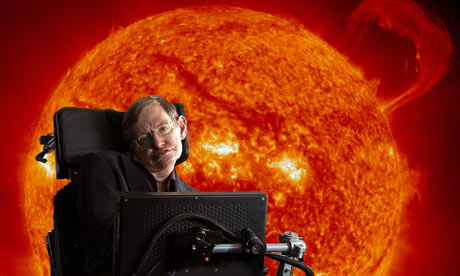
Stephen Hawking has announced that heaven “is a fairy story for people afraid of the dark”. And, because he’s a scientist, he’s allowed to make unscientific statements of belief and present them as virtual fact.
What’s worth doing is to pick out the unscientific assumptions in any statement a scientist makes when they talk about faith (whether they’re pro-faith or not).
Here’s what Professor Hawking said in his interview, complete with an “assumption alarm”:
“I regard the brain as a computer… (ASSUMPTION: just because we know a little of how the brain works, doesn’t mean it is merely an organic computer…)
“which will stop working when its components fail. There is no heaven or afterlife for broken down computers… (ASSUMPTION: the unspoken beliefs here are that a human is nothing more than a brain with a body round it, and that a brain cannot be restarted when it “breaks down”…)
"that is a fairy story for people afraid of the dark (ASSUMPTION: just because the thought of heaven is comforting to those who fear death, doesn’t mean it’s not actually true…).
“The universe is governed by science… (ASSUMPTION: science can’t prove that scientific laws are impersonal and happen to be as they are, rather than the way in which a personal Creator has decided to make and run a universe…).
“[Because we happen to be here] we should seek the greatest value of our action… (ASSUMPTION: this assumes that we know what all the consequences of an action would be, and that we can agree on what the greatest value of an particular action is. This is a moral question, which can’t be answered by scientific endeavour).”
If you’d like to see a useful answer on why science hasn’t disproved Christianity (including the idea of heaven), have a watch of this.
Then Jesus cried out, “When a man believes in me, he does not believe in me only, but in the one who sent me. When he looks at me, he sees the one who sent me. I have come into the world as a light, so that no one who believes in me should stay in darkness. (John 12 v 44–46)

Whatever your views on using the “alternative vote” system to elect our members of parliament*, it won’t have taken you long on the 5th to have made your mark. The voting slip I was handed was a tiny piece of paper with just two sentences and two boxes. I don’t think I’ve ever been so quickly in and out of a voting booth. But it struck me afterwards that as Christians we’re all in favour of alternative voting. Not as a political statement, but what John Stott calls Christian counter-culture. We believe in something most people think is nonsense. In living for Christ, we have a way of life that runs counter to the culture around us. And we stand up and are counted as followers of a leader far less popular than Nick Clegg.
For the message of the cross is foolishness to those who are perishing, but to us who are being saved it is the power of God. For it is written:
“I will destroy the wisdom of the wise;
the intelligence of the intelligent I will frustrate.”
Where is the wise man? Where is the scholar? Where is the philosopher of this age? Has not God made foolish the wisdom of the world? For since in the wisdom of God the world through its wisdom did not know him, God was pleased through the foolishness of what was preached to save those who believe. Jews demand miraculous signs and Greeks look for wisdom, but we preach Christ crucified: a stumbling block to Jews and foolishness to Gentiles, but to those whom God has called, both Jews and Greeks, Christ the power of God and the wisdom of God. For the foolishness of God is wiser than man’s wisdom, and the weakness of God is stronger than man’s strength. (1 Corinthians 1 v 18-25).
There’s one other way in which a vote for Christ is “alternative”. Who we choose in a polling booth is confidential – but our allegiance to Christ must not be. We are all called to be witnesses to Him, and the grace we have received in His name. Some of you reading this are in full-time Christian work like me. I’ve often thought that’s a great advantage in battling our nervous tendencies to keep quiet about our faith when talking to friends and neighbours. After all, they already know we do some strange religious job – so we might as well take advantage of that to reach out with the gospel message whenever we can!
*Britain recently held a national referendum do decide on whether it should reform it's system from "first past the post" to an "alternative vote". The decision was not to change.
 Your weekly filter of news and interesting stuff from the internet.
What does 'Boanerges' mean?
Which is the shortest book in the New Testament?
Who said, "His letters contain some things that are hard to understand"
For how many days did Jesus remain after his resurrection before he ascended into heaven?
Which book starts, "In my former book, Theophilus…"
Which is these was not a plague of Egypt?
No servant can serve two masters…You cannot serve both God and _______
Let love and faithfulness never leave you; bind them around your neck, write them on the tablet of your heart. Then you will win favour and a good name in the sight of God and man.
- Proverbs 3 v 3-4

Christianity Explored is an evangelistic Bible Study course with a difference. Fine-tuned by Rico Tice, minister for evangelism at All Souls Church in London, it uses Mark’s Gospel to explain the Christian gospel. It encourages the church to do evangelism as the church, and not merely as isolated individuals.
The materials for Christianity Explored come in an attractive package of DVDs with clear and well-produced study materials. Rico himself is a gifted communicator with a warm, gracious and infectious enthusiasm for the gospel and the church.
There are many reasons why Christianity Explored is such a helpful tool for our churches.
This kind of fellowship in evangelism stimulates our own people to search the Scriptures better themselves. It binds them together in real fellowship as they pray together, are nervous together, and as together they see God work. As the Lord draws people to himself through his Word, expectation is increased that, on an ongoing basis, the Lord will bring more people to himself. That in turn leads to greater expectation in prayer as we ask him to do just that. At least this was certainly our experience.
Christianity Explored is no more than a tool; but it is a fine tool. And since there is nothing in the world more important than exploring Christianity, it provides a most helpful way of doing just that.

A question on lots of people’s lips at the moment is why God allows all the suffering and pain in the world.
What has been your response in the light of the earthquakes and tsunamis that have struck our planet over the last few months?
All responses welcome.

Over a thousand people went to Bible by the Beach on the south coast last weekend.
If you’ve not been (or not heard of it before), it’s a great few days in Eastbourne: top-notch Bible teaching, a great variety of stuff happening, plenty of chance to relax, and of course fantastic singing with a choir of a thousand. And children love the programme that's provided for them (see pic).
It's also very good value-for-money: though unfortunately the budget doesn't stretch to warming up the English Channel for swimming…
May Bank Holiday 2012: Bible. Beach. Brilliant.