It’s February 13th and all is not calm. Two heartfelt questions are looming large in minds around the globe:
Such questions involve pain. And the issues behind them should not be minimised. But I suspect the original Valentine would be quite surprised that his legacy induced such feelings. His life, or more accurately, his death, poses us a question far more profound than those associated with the temporary struggles of singleness and relationships.
We don’t know much about him but as an early Christian martyr, we can be sure his priorities had little to do with roses, cards or chocolate hearts and everything to do with unswerving faithfulness to Christ. His example leaves us with just one key question that probes deep into the affections of our hearts this Valentine’s Day Eve: Are we willing to give up anything and everything for Jesus?


Therefore, if anyone is in Christ, he is a new creation; the old has gone, the new has come! All this is from God, who reconciled us to himself through Christ and gave us the ministry of reconciliation: that God was reconciling the world to himself in Christ, not counting men’s sins against them. And he has committed to us the message of reconciliation. We are therefore Christ’s ambassadors, as though God were making his appeal through us. We implore you on Christ’s behalf: Be reconciled to God. God made him who had no sin to be sin for us, so that in him we might become the righteousness of God.
(2 Corinthians 5 v 17-21)

I asked a group of Home group leaders this question a couple of months ago: Can you give me a single word that sums up what you think your house group is about?
The answers were varied and interesting. We had caring; fellowship; worship; growth; love; and several others along the same lines. The slightly surprising answer I shared to that question was the one found in Hebrews 10:23-25. Let us hold unswervingly to the hope we profess, for he who promised is faithful. And let us consider how we may spur one another on toward love and good deeds, not giving up meeting together, as some are in the habit of doing, but encouraging one another—and all the more as you see the Day approaching.
Encouragement.
As far as I can tell, this verse in the NT is the only one which actually commands us to meet together as believers. It doesn't specify what day, or in what numbers, or in what set, or subset of the local congregation we should meet. Simply that we should not neglect doing so, and that the purpose of our meeting together is for mutual encouragement. But encouragement for what? The context of the verse tells us.
The writer to the Hebrews has been establishing for his readers some of the enormous privileges of being Christians. And our verse is a part of the paragraph where he sums them up with a call to action. The primary call is to "draw near to God" because Jesus has opened up the way for us to meet with God through his own blood. We should stand before God with absolute confidence, says the writer, because what we receive from Christ is absolute forgiveness, cleansing and removal of our guilt before God.
More than that, the writer tells us that Jesus is our great high priest, who is now in the heavenly temple making intercession for his people.
But we also need (v 23) to "hold fast" to our confession (belief and trust in Jesus as God's one true King) in face of opposition, with the encouragement that "God is faithful". And more than that (v 24) we must think hard how we stir each other up to live the new life that we have received - by doing good to others, and being filled with the love of the Lord Jesus for our lost world. And there is an urgency to this (v 25) because we know that a day is coming when Jesus will return and the world will be judged, and the new creation established.
So central to any gathering of God's people, and therefore your homegroup, I would suggest is that people leave with the following things having been underlined, impressed upon them, stirred up within themselves, or taught to them for the first time:
One lady at the training session said that her aim with the group she leads is "to keep them going as Christians for another week". A brilliant answer. And the way to keep people going, is not just to care for them, and look after their human needs for friendship, food and fun. It is to feed their souls by reminding them of what the Lord has done, is doing and will do for them. It is to remind them who they serve, and what he calls us to.
How does your homegroup match up to this standard?

We hope you have enjoyed our posts on Home groups this week and it's helped to encourage you in this vital ministry within the church family.
As we round up the week we'd love to offer you 30% off all our Home Group Bible study notes. There are 30 Good Book Guides to choose from. They cover the Old Testament, New Testament and topical issues - so plenty to choose from!!
Simply use the code gbg at the checkout. (This offer is valid until 17/02/2012)

Our friends at Matthias Media are just about to launch a new free monthly digest for anyone involved in leading a home group.
Providing you with a regular diet of thought-provoking, Bible-centred articles, videos and book-recommendations, it looks as though this regular email service is going to be a great resource for anyone who wants to be better equipped to lead small groups.
If you are interested in signing up, please click here.

One of the greatest skills that you need to run a good Bible study is the instinct to craft good questions. You know what I mean...
But I've discovered over the years that, as the title suggests, often the best questions are not questions at all. Here's what I mean.
You've asked one of your finely crafted questions, and Janice, a young Christian who doesn't usually say very much, gives a hesitating answer, that shows she's on the right track. You can tell by the wrinkled forehead that she has got a lot more thoughts in her mind, but is unsure about her first answer, so has not said any more. So now is your chance to deploy the finest two words in Bible study history.
Are you ready for them?
Take a deep breath and repeat after me:
"Go on"
Say these two words out loud now - they will change the face of your home group forever!
"Go on"
These words say loads of things to Jittery Janice, or shrinking Stephen, or hesitant
Hannah, or timid Trevor. They tell them:
It's the equivalent of what some books call an "extending question" - but without the need to think of another question. With the right tone, or even prefacing it with "I think you're on the right track here, go on..." or "That's an interesting idea, go on...", you are encouraging them to speak so they can encourage everyone else.
Try it at your next home group meeting, and you will be astonished by the power of these two little words to transform your group.
But a word of caution. Don't tell your group to read this blog post. Word got back to a group I once ran about a training session I ran, where I talked about these magic words. From that time on - all they did when I said "Go On" was laugh at me...
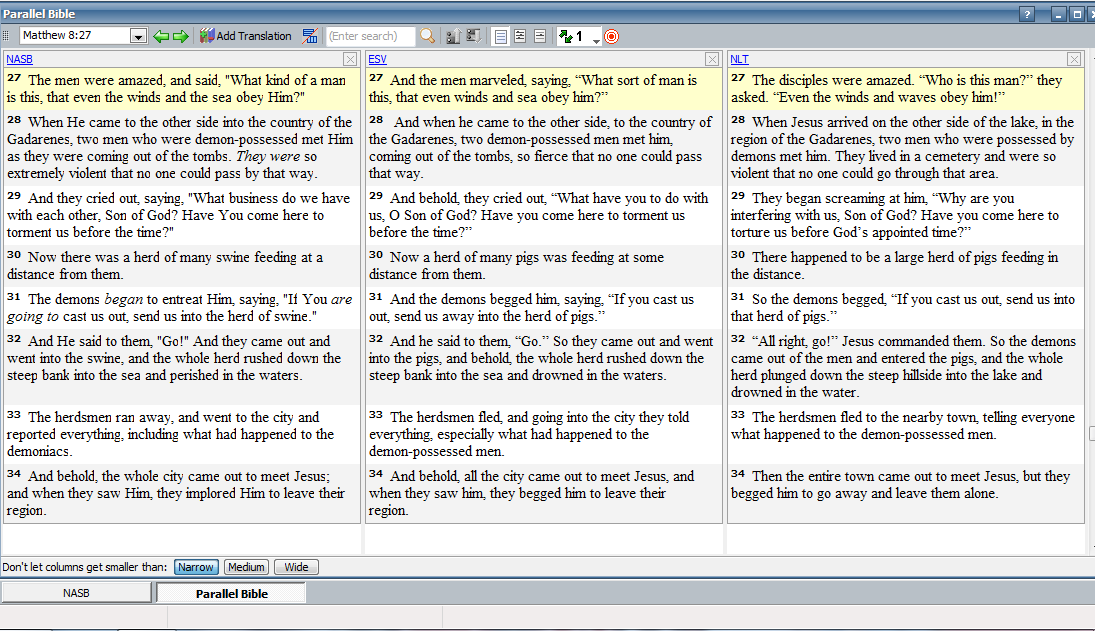
We were boldly plodding our way through Philippians and making great progress until we came to 3 v 3 -- and the evening descended into utter chaos. I won't cloud the issue with the rather complex questions that came out of that particular verse, but the problem was that we had too many Bible translations around the table for our own good. "He has an unhealthy craving for controversy and for quarrels about words" (1 Tim 6 v 4).
The blessing of translations
In the developed world, we are blessed with an extraordinary number of brilliant translations that help us get to the core of what the original text of the Bible is and means. We have literal word for word translations in the tradition of the AV, RV, RSV - the most modern being the New King James, and the English Standard Version.
And we have what are called the Dynamic Equivalence translations that try to translate phrase meanings, rather than words. The versions, like the now almost universal NIV and the New Living Translation (NLT) gain readability, at the expense of their making some decisions about interpretation for us.
And finally there are the paraphrases that do a lot of interpretation, and are more concerned with delivering the impact of the Bible using punchy language and modern idioms and expressions. Like The Message and before that the J B Phillips translation and the Living Bible (or the Living Libel as Ian Paisley used to call it).
Taken individually and together, these translations are a wonderful blessing to us. They help us see the richness and the nuances of the original Bible text. They give insight into what a difficult passage may be talking about, and, in the case of the Paraphrases, suggest brilliant ways of expressing these truths in pithy memorable ways, or even illustrating them with word pictures.
The curse of translations
But when you have a variety of translations around the table, especially when you are with young Christians, or even with those who are not yet Christian, they can be a curse. What could be a fantastic opportunity to talk about the challenge and nature of Christian discipleship, turns into a painful slog through the various semantic registers of the word "Confidence" - the whole study grinding to a halt as we run out of time, energy and willpower.
The tragedy is that the really brilliant things we could have been talking about have been hijacked by the fact that we have too many translations round the table. At their best, they can enlighten discussion. At their worst, they can completely derail it.
My solution? Simple.
Insist that there is a main translation that everyone works from in the group. Choose the translation you use, according to the lowest common denominator. And if "the least of these in the Kingdom" can only cope with the New International Reader's Version, or the excellent NCV, then that's the version to use. For most groups this will mean that you gravitate towards a well used standard version like the NIV.
Of course, in your preparation you will, as leader, make sure you have a look and a read of the passage in a variety of the above translations, so that you will be able to give a steer if a question is raised, without going off on a tangent.
And you won't ban people from using other translations. It's just that you will insist that there is one translation that you all default to. That way, you will spend your time talking about the substance of the passage, not nit picking over the details.
Do people think this is the right approach? What versions do you prefer to use, and why? Answers on a postcard (or alternatively, click the button below).

There are a number of manuals and training courses out there to help small group leaders get skilled up in doing what they do. I honestly think that this is the best available in a single, short, readable volume. In six short chapters Orlando Saer lays the foundations for shaping a home group into a group that will deliver real growth into Christian maturity.
So if you're new to home group leadership, then this little book will give you everything you need to know to get running on the right rails. And if you've been in leadership for years, then it might just be a useful corrective to some bad habits you've got into!
We're doing a special offer on this book at the moment, so follow the link to get a great book at a great price that could turn you into a great leader of a great group!