1. Questions Christians Ask E-Books
For just 48 hours, our very own Questions Christians Ask ebooks are available for just 75p in the UK and $0.99 in the US!
2. Free PDF: Does God Desire All to Be Saved?
A free PDF from John Piper.
3. Indelible Grace Hymn Book
Indelible Grace's newly-designed website, with chords and lead sheets.
4. How can you preach with passion?
A fantastic video by Jonty Allcock about preaching.
5. Prepare Your Public Prayers: Helpful Advice from D. A. Carson
Brian G. Hedges shares helpful advice from D. A. Carson's, A Call to Spiritual Reformation.
6. And finally…
Our video of the week, Tim Chester talks about his book, Ordinary Hero:
Found something that you think should make it on to the On to a Good Thing round-up? Send it to: ontoagoodthing@thegoodbook.co.uk

You probably know The Good Book Company for our biblically focused and - we pray - challenging tree books and resources.
However more and more reading is moving towards a digital format, and although we don't want to see the complete demise of the traditional book, The Good Book Company is keeping up with that trend.
Many of the books we publish and stock are also available in ebook format now alongside their paper counterparts. So now you can take your book with you wherever you take your Apple or Android mobile device, tablet, or other reading device.
To give you a flavour of how these ebook resources look and feel, we are offering our popular Questions Christians Ask series for just 75p each for the next 48 hours. Simply use the code qcae13 at the checkout.
What professions lead to the happiest people? It was a simple question that delivered a surprising result from the General Social Survey produced by the National Organization for Research at the University of Chicago.
It seems the big driver for happiness and job satisfaction is interaction with people. Here's the top five - be prepared for a surprise when you reach no 1:
5. Special education teachers: If you don’t care about money, a job as special education teacher might be a happy profession. The wages are low, but the sense of satisfaction and happiness is high.... continue reading
The suicide bombing of a church in Pakistan a couple of weeks ago, in which at least 85 people were killed, is a horrendous reminder of what Christians in countries throughout the world risk each week simply by going to church.
And, coming as it did at the same time as the Nairobi shopping-centre terrorist attack, in which people were targeted indiscriminately, rather than on the basis of their faith, it has raised a question in the western media, a question which is worth Christians thinking through:
Does it make any difference when the people affected by tragedy are Christians?... continue reading

To him who loves us and has freed us from our sins by his blood, and has made us to be a kingdom and priests to serve his God and Father — to him be glory and power for ever and ever! Amen.
Revelation 1:5b-6
Why not dwell once again this morning on what Jesus has done for you and how he calls you to respond?
Walking the Walk, Not Just Talking the Talk
When I was growing up, my world seemed pretty simple. At school and as a young man being religious meant being a Christian. I didn't know many Jews, Muslims, Hindus, or Buddhists. I didn't really even know anything about them. Today things are different, even if we don't always notice it, mosques, synagogues, and temples are everywhere. As for churches you’ll find Anglican, Catholic, Episcopal, Lutheran, Evangelical, Presbyterian, Methodist, and many other traditions.
In addition, it's not uncommon to hear people say, I'm not religious, but I am spiritual. People who talk like that tend to be theologically eclectic. They’re concerned that such entities as above, whether big or small, Christian or not, might put boundaries on their ability to pick and choose what they believe and practice. So with all of this religious and spiritual diversity, what does it mean to be a Christian? What are the biblical beliefs we need to focus on to stay true to God? What are the basic Christian truths we need to hold on to and understand to shine out as a light for Christ in an ever more secular world and one full of "alternative" religion and spirituality?... continue reading

Christians now suffering mass martyrdom, says Archbishop of Canterbury
Anglicans appoint first female bishop in UK and Ireland
Potentially hundreds dead in Peshawar church bombing
Christian B&B owners Hazelmary and Peter Bull 'forced to sell up'
Teacher 'forced out of school’ for failure to wear Muslim hijab
Disclaimer: The Good Book Company is not responsible for the content of external sites and does not necessarily agree with the content of articles listed.
A Christian need never feel harassed, nor experience helplessness. Never.
Why?
Because a Christian is never without a shepherd.
Life is full of harassed-inspiring challenges and busy-ness, and helplessness-inducing events and unknowns. It’s what Jesus noticed about people as he travelled round, preaching and healing; it’s what aroused his compassion for them:
“He had compassion on them, because they were harassed and helpless, like sheep without a shepherd.” (Matthew 9 v 36)
If you don’t have a “shepherd”—someone to rely on who is in control, who knows what they are doing, and cares about you as their own possession—then you’re going to know the feeling of being harassed and helpless, because you’re thrown back on your own abilities, and life is so often too big or confusing for our minds and strength to handle. If you don’t have a shepherd, you will be harassed and helpless.
And so Jesus gave his famous command to his disciples—the harvest field is vast, the workers are few, and therefore to pray for workers, and go out as workers (9 v 37 – 10 v 2).... continue reading
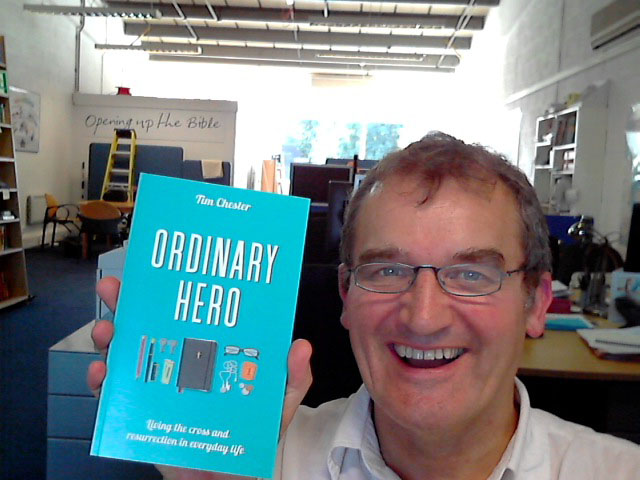
It's always a thrilling moment when a new book arrives in the office from the printer. Thrilling but tense. After a huge amount of effort has been put into editing, crafting, shaping and designing, the book gets passed around the office. What happens next is an interesting exercise in testing our professionalism as a publisher.
As a book get's passed round people who have not been part of the process they react to it in the same way that anyone does when they pick up a book in a bookshop. They ask the following questions:
And of course...
When it is a product I have overseen, I usually finish this process by taking a "selfie" with the book, and sending it to the author.
Then the whole process starts again...
We picked up the rights to publish and promote Tim Chester's excellent book, Ordinary Hero, in the US, which will be launching in a few weeks' time - have a look at the UK version HERE - it's terrific!
1. Deep: The Trinitarian Life 2013 Talks
Listen to the main talks from the recent Acts 29.
2. The Front Porch
A new website about biblical faithfulness in African-American churches and beyond.
3. 5 Minutes in Church History
Another new website, this time with podcasts about church history.
4. 10 Tips for Discipling Your Kids
Justin Buzzard shares 10 tips for discipling children.
5. Six Benefits of Ordinary Daily Devotions
Jon Bloom at Desiring God looks at these six benefits.
6. 5 ways to do social media better
Dave Bish looks at these five ways.
7. And finally…
Our video of the week, Andrea Trevenna talks about her new book, The Heart of Singleness, which is released in October:
Found something that you think should make it on to the On to a Good Thing round-up? Send it to: ontoagoodthing@thegoodbook.co.uk