| 10+ copies | 30% off | £10.50 each |
Discounts applied automatically in your basket.
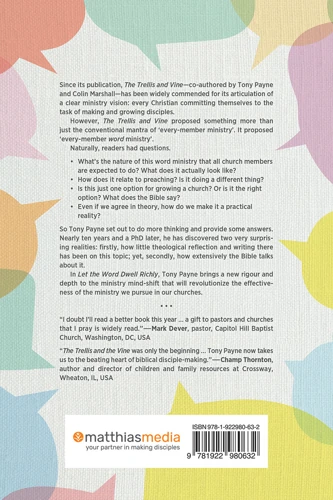
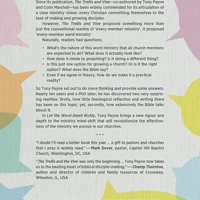
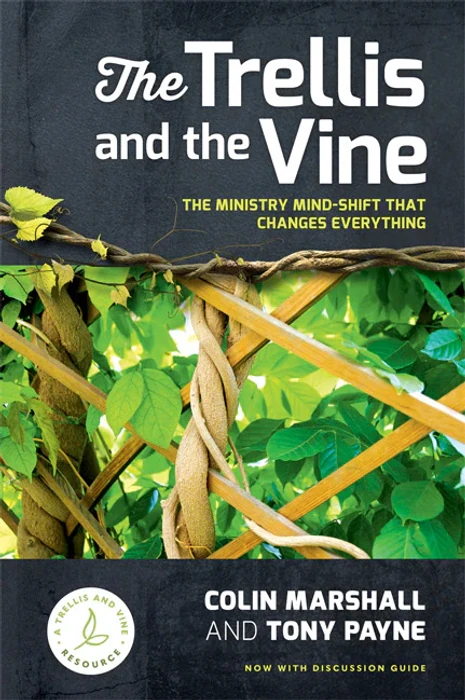
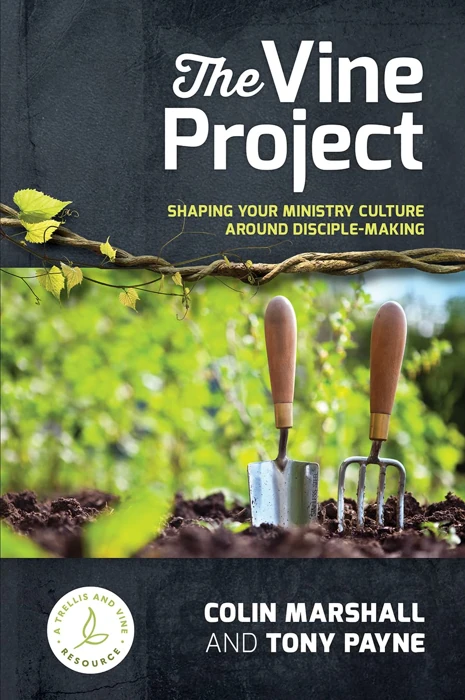
Since its publication, The Trellis and Vine—co-authored by Tony Payne and Colin Marshall—has been widely commended for its articulation of a clear ministry vision: every Christian committing themselves to the task of making and growing disciples.
However, The Trellis and Vine proposed something more than just the conventional mantra of ‘every-member ministry’. It proposed ‘every-member word ministry’.
Naturally, readers had questions.
So Tony Payne set out to do more thinking and provide some answers. Nearly ten years and a PhD later, he has discovered two very surprising realities: firstly, how little theological reflection and writing there has been on this topic; yet, secondly, how extensively the Bible talks about it.
In Let the Word Dwell Richly, Tony Payne brings a new rigour and depth to the ministry mind-shift that will revolutionize the effectiveness of the ministry we pursue in our churches.

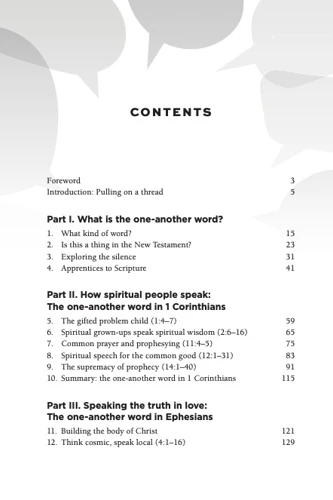
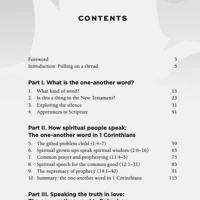
Foreword
Introduction: Pulling on a thread
Part I. What is the one-another word?
1. What kind of word?
2. Is this a thing in the New Testament?
3. Exploring the silence
4. Apprentices to Scripture
Part II. How spiritual people speak: The one-another word in 1 Corinthians
5. The gifted problem child (1:4–7)
6. Spiritual grown-ups speak spiritual wisdom (2:6–16)
7. Common prayer and prophesying (11:4–5)
I doubt I’ll read a better book this year. Tony Payne has taken decades to study, reflect, practice and write this book. In brief, his idea is that the Bible teaches us that as surely as pastors are to exercise the public ministry of the word proclaimed, so surely is every Christian to exercise the personal one-another word ministry. What is one-another word ministry? It is Christian speaking to Christian to edify, correct, encourage and instruct. The book is full of careful reading of the Bible—giving special attention to 1 Corinthians, Ephesians and Hebrews—thoughtful synthesizing of the truths it teaches, and experienced practical reflections. Let the Word Dwell Richly is a gift to pastors and churches that I pray is widely read. May the Reformational recovery of the ministry of God’s word in our lives and churches continue, and may this book be used to help it.
Tony Payne tackles a topic central to the apostolic teaching of the New Testament—yet often neglected in our own churches—with biblical clarity, theological depth and practical wisdom. He offers rich and timely insights that we need to heed and take to heart.
This book is the fruit of long and patient attention to the word of God, shaped by years of careful thought, reflection and study within the life of the church. Tony has given us what may at first appear to be a timely reminder of the importance of “one-another” ministry, but which proves on closer reading to be something far more profound. It is a call to recover confidence in the power of God at work in our churches by multiplying and amplifying the word of God throughout the whole congregation, as every member takes up the calling to speak the truth in love to one another.
The pulpit is, of course, central to the church’s life. Yet when the public ministry of the word is received and carried into every part and aspect of the church’s shared life, something genuinely transformative takes place. Ordinary believers are drawn into the great dignity of speaking God’s own words to one another as instruments of his grace.
This is a stimulating, timely and potentially very fruitful book. It presses us to think carefully about ministry, maturity and mutual care, and to reckon afresh with the way God uses his word—spoken from one believer to another—as a living means of grace. I warmly commend it to pastors and church leaders who are seeking to cultivate a church life marked by the richness and fullness of the whole body of Christ at work.
The Trellis and the Vine was only the beginning. In Let the Word Dwell Richly, Tony Payne now takes us to the beating heart of biblical disciple-making.
Every year sees a huge wave of new books on preaching—and for good reason. God’s word brings life, and the pastoral ministry of the word must remain central in the church. Yet the New Testament also insists that the word must not stop at the pulpit. Pastors know the bottleneck: when everything depends on the professionals, discipleship stalls and church health suffers. But the church grows when ordinary Christians ‘speak the truth in love’ to one another—encouraging, warning, comforting, instructing and building up one another with Scripture.
Throughout church history, God has used certain books to recover neglected dimensions of the Christian life—whether Luther on justification, Carey on missions, or Packer on knowing God. In that same spirit, Let the Word Dwell Richly calls us back to the vital yet easily forgotten power of “the one-another word”. Tony Payne carefully traces this theme through 1 Corinthians, Ephesians and Hebrews. His analysis, synthesis and conclusions are exegetically rigorous, theologically rich, and profoundly practical. This is a big book with an even bigger vision: Scripture-shaped conversation is essential for discipleship, church health and perseverance in the faith.
This is a book that unsettles—in the best possible way. It confronts comfortable assumptions and gently but firmly exposes an often-unintentional neglect of the New Testament’s “one-another” ministry of the word.
Long overdue, this work addresses a strikingly under-served area of Christian thought and practice. From the outset, Tony makes clear both the biblical importance of the subject and the paucity of material devoted to it. His contribution is therefore not only timely, but also deeply needed.
With a theology-that-leads-to-practice approach, Tony calls readers to re-evaluate the balance of their ministry. As he carefully works through 1 Corinthians, Ephesians and Hebrews, I found myself confronted about my own ministry, as resistance gave way to conviction. The book demands effort—but it is the rewarding kind. Written with clarity and accessibility, it never oversimplifies. Tony is unafraid of complexity and invites his readers to grapple alongside him with the deep truths of Scripture.
Crucially, this book restores emphasis to the vital “one-another” word without diminishing the place of preaching. Instead, it elevates the often-neglected word ministry of every Christian. Its rigorous handling of Scripture is matched by a rich engagement with the Reformers, offering particular delight in its exploration of their understanding of preaching.
Above all, this book rekindles wonder at a great God who speaks clearly, who graciously shares his word with his people, and who uses that word—democratized and dispersed—to ensure his church remains edified, engaged and growing.
From a careful study of the New Testament, grounded in sound interpretive method, Tony argues for a commonly neglected element of Christian discipleship. The ministry of speaking the word of God to one-another should be the normal God-given experience of the Christian life and church ministry.
From his study of historical theology, Tony concludes that the 16th-century Reformation of the church by the public preaching of the gospel word did not go far enough. Luther and Calvin expounded the revolutionary biblical truth of the priesthood of all believers. But they failed to draw the implication that all believers are servants of the word, speaking God’s word to fellow-believers and to the lost. To this day, our churches suffer from this commonly neglected doctrine and practice.
The effort of equipping our members to fulfil this vision will pay huge dividends. The formal preaching of pastors will have greater impact as members help one another learn deeply. And our various ministry structures in church life will be more fruitful for maturity and mission.
Viva la Reformation!
If early church history clarified the divinity of all three persons of the Trinity, and the Reformation clarified the priesthood of all believers, then this most recent century has finally seen serious work begin on the ministry of all believers. Or has it?
With the theological and exegetical rigour we expect from Tony Payne, this book skilfully explores the neglected topic of one-another word ministry. But be prepared: you will be forced to check your assumptions at the door and rethink certain key passages of Scripture. If you’re like me, you’ll know you’re reading a significant work when you regret that you laid eyes on it only after preaching through the relevant passages.
This book is an urgent plea to unleash God’s word from the mouths of all of God’s people and, as Tony puts it, to no longer “constrain the communication of the word of God to one context only (the church service), by one person only (the preacher), in one form of speech only (the sermon), as many churches in history have done and continue to do today”. May we heed this call, by God’s grace.
Tony Payne has made a significant contribution to the doctrine of the church by analyzing what the New Testament says about one-to-one ministry by all Christians. What he says, and the conclusions he draws, constitute a challenge to every Christian about our calling to ‘speak the truth in love’ to one another. His work throws light on contentious issues such as the gift of prophecy and the ministry of women. Most important, however, is the way in which we are helped to think again what church is for and the responsibilities of all who belong. I hope that his work will enrich all our churches and enable us to show forth the faith, hope and love described in 1 Corinthians 13.