 Half of young adults don’t consider themselves exclusively heterosexual, a survey has shown. As Bible-believing Christians, we should be encouraged. Allow me to explain.
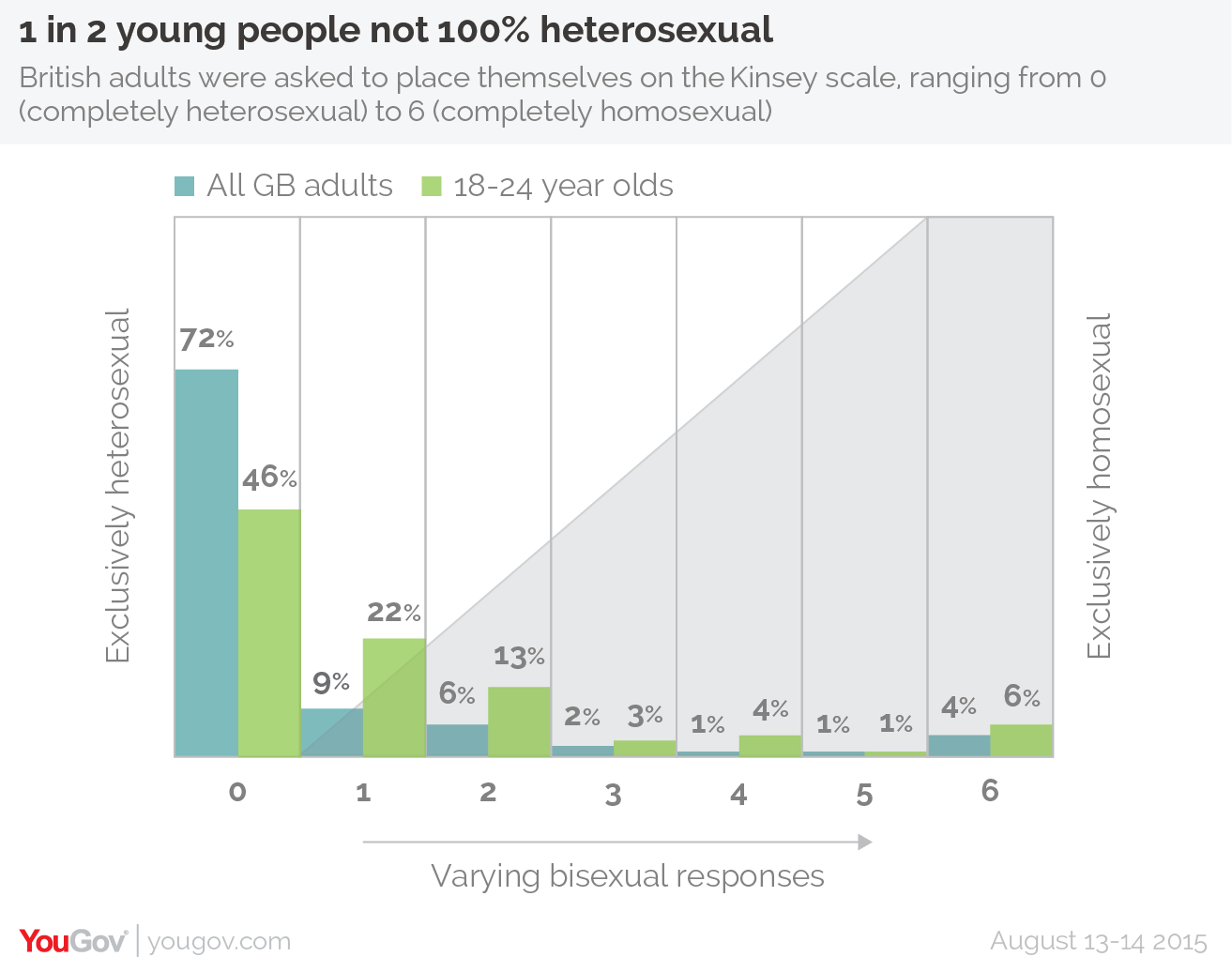
The poll by YouGov asked 1632 participants to place themselves on the Kinsey Scale, a classification of sexual orientation. The scale runs from 0 (exclusively heterosexual) to 6 (exclusively homosexual), with five options in between, such as "predominantly heterosexual, only incidentally homosexual" (a number 1) and "predominantly homosexual, but more than incidentally heterosexual" (a number 4).
Over all age groups, 28% of people don’t consider themselves to be exclusively heterosexual—a figure that rises to 48% of young people.
The report in The Daily Telegraph concluded: "Every generation sees sexuality as something which is slightly less set in stone, according to the report."
How is this good news?
The idea that sexuality might be “set in stone” at all is actually a fairly recent idea.
Hear me out.
There have been men who fancy men, and women who fancy women, since time immemorial. But sexuality hasn’t always been such a big deal. The French philosopher Michel Foucault argued that it’s only in fairly recent history that a person’s sexual appetite has become more than incidental, and instead a part of our identity.
Sam Allberry, author of Is God Anti-gay?, writes:
“When someone says they’re gay, or for that matter, lesbian or bisexual, they normally mean that, as well as being attracted to someone of the same gender, their sexual preference is one of the fundamental ways in which they see themselves. … We live in a culture where sexuality is virtually equated with identity: ‘You are your sexuality.’ We are encouraged to think that to experience homosexual feelings means that you are, at your most fundamental core, a homosexual.”
We live in a culture where sexuality is virtually equated with identity: ‘You are your sexuality.’
 And it’s partly this sense of identity which has brought Christians in the West into conflict with the culture around us. The Christian cliché is to say that we “hate the sin, but love the sinner”. But this brings us into difficulties. Sometimes that’s because we are not, in fact, genuinely loving “the sinner”—this is to our shame. But we also run into difficulties because to divide the sin from the sinner seems impossible in the minds of our 21st-century neighbours. So it’s hard for Christians to express that a certain sexual behaviour is wrong without it being construed as an attack on the core of that person’s very being.
So that’s why we can be encouraged by YouGov’s recent research. As our culture moves away from understanding sexuality in fierce binary terms of gay-or-straight, one-or-the- other, all-or-nothing—and towards a more nuanced understanding of sexual appetites—perhaps more people will also begin to see sexual appetites as less fundamental to their individual identities. That would be both closer to biblical truth, and wonderfully liberating—all of us are so much more, so much more brilliantly complex, than what we do or don’t do in bed.
However views on sexuality change in the future, Christians are called to love “sinners” wherever they are on the Kinsey scale, knowing that—whether we’re at 0 or 6 ourselves—we’re sinners on the Kinsey scale too: but that does not define us.
Now you've read the article, let us know what you think. Comment in the box below. You can also like us on Facebook, follow us on Twitter, and subscribe to our YouTube Channel

Rachel Jones is the author of A Brief Theology of Periods (Yes, Really), Is This It? and several books in the award-winning Five Things to Pray series, and serves as Women's Ministry Lead at King's Church Chessington, in Surrey, UK.